Prayer
Denver Prayer Times and It’s Spiritual Meaning

Understanding denver prayer times is essential for Muslims living in or visiting the city who want to observe their daily prayers accurately and consistently. The five daily prayers form the backbone of Islamic worship, structuring the day around remembrance of God. Because prayer times are determined by the position of the sun, they vary depending on geographic location and season. That means prayer times in Denver differ significantly from those in cities across the United States or elsewhere in the world.
This comprehensive guide explains how denver prayer times are calculated, what influences seasonal variations, where to verify accurate schedules, how to spiritually prepare for each salah, and includes meaningful sample prayers you can recite before or after your obligatory prayers.
Also Read: LDS Prayer Roll Meaning, Purpose, and How It Is Used in the Church
The Importance of Daily Prayer in Islam
Before discussing denver prayer times specifically, it is helpful to understand why timing matters so much in Islam. The five daily prayers are not random acts of devotion. Each prayer has a prescribed time window that begins and ends based on the sun’s position.
The five daily prayers are:
Fajr, performed before sunrise
Dhuhr, performed after midday
Asr, performed in the afternoon
Maghrib, performed just after sunset
Isha, performed at night
Observing these times accurately reflects obedience and discipline. Prayer at its proper time is highly emphasized in Islamic teachings. It nurtures mindfulness, gratitude, humility, and consistency in worship.
Why Denver Prayer Times Are Unique
Denver is located in the Mountain Time Zone in the western United States. Its geographical coordinates and elevation significantly influence local prayer times. Denver sits approximately 5,280 feet above sea level, earning it the nickname Mile High City. Elevation affects how quickly the sun rises and sets relative to the horizon.
Because prayer times depend on sunrise, sunset, and the sun’s angle below the horizon, slight variations can occur compared to lower elevation cities at similar latitudes.
In addition, seasonal shifts in daylight are noticeable in Denver. Winters bring shorter days and longer nights, while summers offer extended daylight hours. As a result:
Fajr is very early in summer and later in winter
Maghrib occurs much later in summer and earlier in winter
Isha can be quite late during peak summer months
How Denver Prayer Times Are Calculated
Prayer times are calculated using astronomical data. The position of the sun relative to the earth determines when each prayer begins.
Fajr begins when the first light appears before sunrise, known as true dawn.
Dhuhr begins when the sun passes its highest point in the sky.
Asr begins when an object’s shadow equals or exceeds its length, depending on the calculation method.
Maghrib begins immediately after sunset.
Isha begins when twilight disappears and the sky becomes fully dark.
Islamic organizations use calculation methods based on degrees of solar depression below the horizon. One commonly referenced standard in North America comes from the Islamic Society of North America, which uses specific angle measurements for Fajr and Isha.
Because there are slight differences in calculation methods, prayer times published by different apps or mosques may vary by a few minutes. For practical purposes, it is recommended to follow your local mosque’s timetable to maintain unity in congregation.
Where to Find Accurate Denver Prayer Times
There are several reliable ways to access up to date denver prayer times:
Local mosque websites often publish monthly prayer calendars.
Mobile apps allow you to set Denver as your location and choose a calculation method.
Islamic community centers provide printed schedules.
Online Islamic prayer time websites update automatically based on location data.
When using digital tools, ensure that location services are enabled and that the correct calculation method is selected. This prevents confusion, especially during daylight saving time transitions.
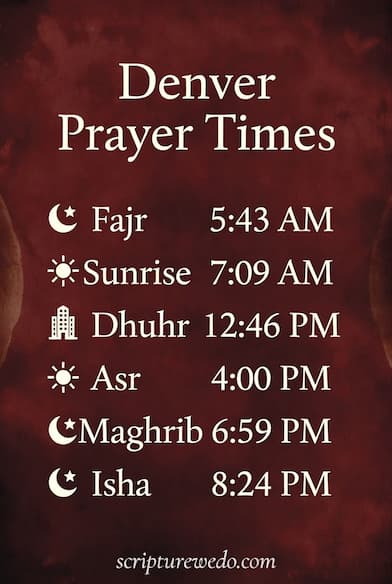

Seasonal Variations in Denver Prayer Times
Winter Prayer Patterns
During winter months, sunrise occurs later and sunset happens earlier. This leads to:
Fajr beginning later in the morning
Maghrib and Isha occurring relatively early in the evening
This season can make it easier for families to pray Isha together at a reasonable hour. However, colder weather may make attending early Fajr in congregation more challenging.
Summer Prayer Patterns
Summer in Denver brings long daylight hours. In June and July:
Fajr can occur very early, sometimes before 4:00 AM
Maghrib may be as late as 8:30 PM or later
Isha may begin quite late at night
This can require adjustments to sleep schedules, especially for working professionals and students. Planning rest periods and maintaining discipline becomes essential.
Understanding the Spiritual Meaning of Each Prayer
Fajr
Fajr marks the start of the day. It is prayed before sunrise, during a quiet and reflective time. Spiritually, it represents new beginnings and reliance on God before engaging in worldly responsibilities.
Sample supplication after Fajr:
“O Allah, bless this day for me. Guide my thoughts, my words, and my actions. Protect me from harm and help me fulfill my responsibilities with honesty and patience.”
Dhuhr
Dhuhr occurs after midday, often during busy working hours. It is a pause in the middle of daily activity. Praying Dhuhr reminds believers that success ultimately comes from God.
Sample supplication after Dhuhr:
“O Lord, as I continue my work today, keep my intentions pure. Let my efforts be beneficial and protect me from pride or carelessness.”
Asr
Asr falls in the late afternoon when energy may decline. Spiritually, it reminds believers that life is passing and accountability is real.
Sample supplication after Asr:
“O Allah, forgive my shortcomings today. Strengthen me in faith and help me finish this day in obedience and gratitude.”
Maghrib
Maghrib comes just after sunset. It marks the transition from day to night and is often prayed shortly before or after breaking fast during Ramadan.
Sample supplication after Maghrib:
“O Most Merciful, thank You for bringing me safely through this day. Accept my prayers and forgive my mistakes.”
Isha
Isha is the final prayer of the day. It closes daily worship and prepares the heart for rest.
Sample supplication after Isha:
“O Allah, grant me peaceful sleep. Protect my family and awaken me tomorrow with renewed faith and strength.”
The Direction of Prayer in Denver
Muslims in Denver pray facing the Kaaba in Mecca. From Denver, the qibla direction is generally northeast. Most mosques and Islamic apps provide accurate qibla directions using compass features.
Ensuring proper direction enhances focus and unity with Muslims around the world who face the same sacred site.
Congregational Prayer in Denver
Denver has a growing Muslim community with several mosques offering daily congregational prayers and Friday sermons. Attending congregational prayer brings additional spiritual reward and strengthens community bonds.
Friday prayer replaces Dhuhr on that day and includes a sermon. It is highly emphasized for adult Muslim men and encouraged for women when feasible.
Planning Your Day Around Denver Prayer Times
Integrating prayer into daily life requires organization.
Set reminders on your phone.
Keep a small prayer mat at work or in your car.
Communicate your prayer schedule respectfully with employers or teachers.
Plan meetings around Jumuah when possible.
Many workplaces in Denver are diverse and accommodating when prayer needs are explained professionally.
Special Considerations During Ramadan
During Ramadan, denver prayer times become even more central. Fasting begins at Fajr and ends at Maghrib. Accurate timing is crucial.
Taraweeh prayers follow Isha during Ramadan nights. Because Isha can be late in summer, managing sleep becomes important.
Common Questions About Denver Prayer Times
Do prayer times change every day?
Yes. Because sunrise and sunset shift gradually throughout the year, prayer times change daily by a few minutes.
What happens during daylight saving time?
Clocks shift forward or backward, which affects published times. Most apps update automatically, but always verify after time changes.
Can I combine prayers?
In certain circumstances such as travel or hardship, combining prayers is permitted according to Islamic jurisprudence. However, this should be done according to proper guidance.
The Spiritual Impact of Observing Prayer on Time
Praying at the correct time builds discipline. It shapes your schedule around worship rather than squeezing worship into leftover time. Over weeks and months, this consistency strengthens faith and inner peace.
Observing denver prayer times also creates a rhythm to daily life. Dawn begins with reflection. Midday includes gratitude. Afternoon invites accountability. Evening encourages thankfulness. Night closes with surrender.
Creating a Personal Prayer Routine
You can deepen your connection by adding voluntary prayers around the obligatory ones. Sunnah prayers before or after Fajr, Dhuhr, Maghrib, and Isha bring additional blessings.
You may also set aside a few minutes daily for personal supplication in your own language. Speak openly about your needs, fears, and hopes.
Example personal dua:
“O Allah, You know my struggles and my aspirations. Guide me in every decision. Strengthen my faith in times of doubt. Make my prayers a source of comfort and light.”
Teaching Children About Denver Prayer Times
If you have children, involve them in learning prayer schedules. Display a printed monthly timetable at home. Encourage them gently and celebrate consistency rather than perfection.
Teaching the meaning behind each prayer helps them understand that it is not simply a routine but a relationship with their Creator.
Conclusion
Denver prayer times reflect the natural movement of the sun across Colorado’s skies. They shift with the seasons, challenge believers to adapt, and invite daily discipline. By understanding how prayer times are calculated and by organizing your day thoughtfully, you can observe each salah with confidence and devotion.
Whether you are a lifelong resident or new to the city, aligning your schedule with accurate denver prayer times strengthens your connection to God and to the global Muslim community. Each call to prayer becomes an opportunity to pause, reflect, and realign your heart.
Consistency in prayer transforms ordinary days into spiritually grounded experiences. When observed sincerely and on time, each prayer becomes more than an obligation. It becomes a moment of peace in a busy world and a reminder that no matter where you live, you are never distant from divine guidance.